



Compostable packaging does its intended job only when it ends up at a facility built to process it. Unfortunately, composting infrastructure in the U.S. doesn’t reach every business the same way.
So when a customer asks you about switching from regular plastic, the honest answer is often “it depends.” Composting facility access changes by location and by the type of business asking.
This guide covers how composting works at scale, what changes by segment, and how to set your customer’s expectations before you sell a program their local infrastructure can’t support.
How Industrial Composting Works
Before getting into how composting differs by segment, you should know what “commercially compostable” requires in practice.
A facility that processes food waste at scale follows a few basic steps:
- Sort and Shred: Incoming materials from your customers’ organic bins get separated and broken down to increase surface area.
- Active Composting: The material is held at 131°F to 160°F for several days, which kills pathogens and breaks the material down.
- Cure and Screen: The compost rests, then gets screened to filter out anything that hasn’t broken down yet.
Certified products are designed to disintegrate within about 90 days under these conditions, though different biopolymer types break down at different rates.
Home/industrial compostability certification confirms the material is built to turn to compost at the end of life.
However, it doesn’t guarantee your customer’s local facility will take it. Composters are selective, since plastic contamination costs them money to remove.
A Closed Loop Partners study found it eats up about 21% of their operating costs, mostly because conventional plastic is mistaken for compostable packaging.
How Composting Works by Type of Foodservice Business
Composting isn’t the same for every business, even within the same state. It depends on who’s sorting the waste and how much space a business has for it.
The sections below cover what that looks like for quick-service restaurants, healthcare, hotels and event venues, schools, and corporate dining:
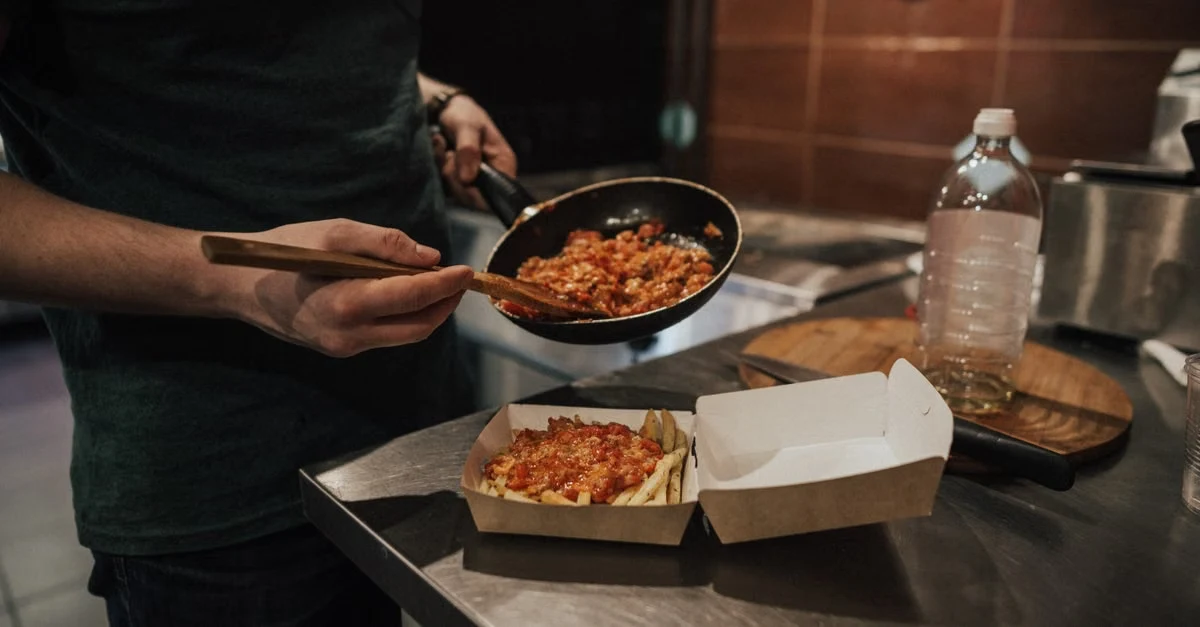
Quick-Service and Fast Casual
Quick-service and fast casual restaurants serve a lot of customers every day, so they throw away a lot of packaging.
Setting up composting here means dealing with 2 spots: the kitchen and the counter.
The kitchen is the easier one. Staff already sort food waste as part of their job. Adding a compost bin next to the trash can is a small change for them.
The counter is harder. A new customer walks up every few minutes. Most have never used a compost bin before. Most won’t stop to read a sign either.
What tends to work:
- Switch the Whole Counter to Compostable: Use compostable straws, trays, plates, bowls, and cutlery everywhere at the counter. That way, customers don’t have to guess what’s compostable and what isn’t.
- Have Staff Remind Customers: A sign by itself often doesn’t work. A staff member reminding customers during busy hours works better.
Healthcare and Senior Living
Hospitals and senior living facilities have a rule other segments don’t have to worry about: food waste and medical waste can never mix.
Kitchen scraps count as food waste. But anything touched by bodily fluids or sharps in a patient care area counts as medical waste instead.
Medical waste can cost up to 10 times more to throw away than regular trash. Accidentally mixing the two gets expensive.
Health department rules add another layer. They’re different in every state. Kitchens also serve a lot of meals in a small space. A 1,000-bed hospital can serve more than 8,600 meals a day.
There’s not much room left over to add new equipment.
How to make this work:
- Start Small, With the Cafeteria: It’s much easier to set up composting in a cafeteria or retail food area than in a clinical area. Leave patient rooms and public floors out of it until sorting is consistent.
- Keep It Staff-Run at First: Staff can be trained to sort waste correctly. Patients and visitors can’t be, unfortunately.
Schools and Universities
Schools and universities have the most upside for teaching kids about composting. They also see some of the highest contamination rates. A cafeteria compost station can teach kids how sorting works.
Kids and other first-time users normally make more sorting mistakes than trained staff. Public drop-off points see the most contamination because of this.
Ohio University shows what can go wrong. Its dining halls have composted food waste since 2009 without any problems. But when it added a bin at its student union, a public space, that changed.
Chip bags, plastic lids, and utensils kept ending up in the compost. The state warned the university it could lose its composting permit if the problem continued.
In the end, the university stopped collecting compost at the student union. Its other locations, staffed by trained employees instead of the public, still work fine.
How to set this up in schools:
- Start With the Sustainability Office: Schools run and fund these programs through that office, so it’s the team that approves a switch.
- Dining Staff Sort at the Tray Return: Students drop their trays on a return belt. Staff sort the food waste and packaging out of sight. Trained people handle every bin.
- Where the Composting Happens Depends on the School: Some large universities compost on their own campus land. Ohio University is one of them. K-12 districts don’t have the land or the budget for that. They need a hauler who already picks up food scraps nearby.
Hotels and Event Venues
These venues deal with a different kind of volume problem. It comes in spikes.
A single large conference or a week of event programming can generate as much waste in a few weeks as a typical restaurant sees in months.
Guest-side contamination is also a bigger issue here than in quick-service settings, since guests are visiting for a day or two and have no idea how the venue’s bins work.
One convention center’s audit found a mere 17.6% of food waste ended up in the right bin when guests sorted it themselves at front-of-house stations.
None of the paper towels made it into the right bin either, though back-of-house staff got it right throughout.
Best practices for this segment:
- Keep Composting to the Kitchen Side: Banquet staff get trained before each event. They do the same prep work repeatedly, so sorting waste becomes part of the job. That’s why the kitchen side of these programs holds up better.
- Staff Any Bin Guests Will Use: A bin left on its own in a guest area tends to fill with the wrong things. Someone needs to stand near it during busy periods.
Corporate Dining
Composting works better in office cafeterias than in almost any other segment. The reason is who eats there. The same employees come in most days, so they learn where the compost bin is and what goes in it.
Compare that to a fast-food counter, where a stranger walks up every few minutes and has to figure it out from a sign.
Most of the waste never reaches those bins anyway. It comes from the kitchen, where staff peel, trim, and prep food all morning. Those workers are trained, so they sort scraps into the compost bin as they go.
That front-of-house sorting still improves over time. Clear labels help, and so does a quick mention of the program when someone joins the company.
Two more things to check before you sell compostable packaging to an office cafeteria:
- Ask Whether They Report Sustainability Numbers: Many of these companies already publish those figures each year. Compostable packaging gives them a real number to include.
- Find Out Who Controls the Waste Contract: Office cafeterias tend to sit in leased buildings, which means the landlord picks the hauler. Your customer may need building management to approve the switch before adding compost pickup to the building’s contract.
How the Segments Compare
The table below shows where composting programs in each segment tend to hold up and where they may break down:
Questions to Ask Customers Before Pitching Compostable Packaging
A few quick questions upfront save you from promising something a customer’s location can’t handle:
- Does the location’s waste hauler offer food-scrap or organics pickup at all?
- Does the local composting facility accept packaging, or food scraps alone? (These aren’t the same thing.)
- Will the front-of-house lineup be all-compostable, or a mix with recyclables? (Mixing invites contamination.)
- Is there physical space for another bin near the loading dock or back door?
- Who moves the full bin out? What happens when that person is out sick?
- What’s staff turnover like? Who trains new hires on sorting?
- What does the hauler charge if a load comes back contaminated?
What to Offer Customers When Composting Infrastructure Isn’t Available
When there’s no composter nearby, you can promote PFAS-free instead. That benefit doesn’t depend on local infrastructure at all.
PFAS are a group of long-lasting chemicals, sometimes called “forever chemicals.” Manufacturers add them to some conventional food packaging as a grease-resistant coating.
Your customers care because the rules are tightening on PFAS:
- More Than a Dozen States Now Restrict PFAS in Food Packaging: The list keeps growing each legislative session.
- Several of Those Laws Name Distributors as Liable: You can be held responsible alongside the manufacturer for selling noncompliant products.
So the risk sits on your side of the sale too.
Certification is the way out. BPI certification already rules out PFAS, since the standard requires it. NantBioRenewables’ straws carry BPI and TÜV Austria certification along with USDA Biobased status.
That means if you stick to certified products, you don’t have to track test results state by state.
You can now request the full PFAS test report set, along with all certifications, at [email protected]. You can also query which certifications apply to the SKUs you stock.
Where Composting Infrastructure Is Headed
Composting capacity is growing, though at a slow pace. A 2025 grant program funded by composting industry groups added collection capacity for about 240,000 households.
Progress like that helps, but it won’t close the national gap for years.
So the access problem you’re working around today may still be there next year.

Why Distributors Choose NantBioRenewables
Composting is a real, sellable story in the segments and locations where the infrastructure supports it. Everywhere else, PFAS-free compliance and regulatory pressure carry the conversation well on their own.
Either way, quality matters most. Your customers need a supplier who delivers consistent supply and consistent quality, order after order. A U.S.-based supplier makes that easier to guarantee.
At NantBioRenewables, we manufacture our Wave Ware™ line in Gadsden, Alabama. The line covers straws, cutlery, plates, trays, and bowls.
A few things worth knowing about what we make:
- A Material Built for Performance: Many products use Ocean Calcium Sand, a carbon-negative material sourced from the Bahamas. We also offer cellulose diacetate, PLA, and polypropylene, so distributors can match the material to a customer’s use case.
- Certifications That Vary by Product: Depending on the material, our products carry BPI, TÜV Austria, USDA Biobased, or CMA Approved certification. Full documentation is available for whichever one a customer needs to see.
- Strength That Matches Plastic: These materials are engineered to match traditional plastic in strength and usability. After use, they break down without leaving microplastic behind.
Want to put a sample in front of a customer? Request a sample or talk to a packaging specialist by filling out the form below, or email us at [email protected]. We’ll help you find the right fit.