



When you’re sourcing compostable packaging, one of the first questions worth asking is a simple one: Where was this actually made?
The answer affects your costs, your timelines, your products’ shelf-life, your compliance exposure, and how much risk you carry in your warehouse.
This guide breaks down the sourcing decision for distributors. No “buy American” preaching, just the practical factors that should go into your evaluation.
Where Compostable Packaging Actually Comes From
If you source compostable packaging, chances are most of it comes from overseas. China supplies a large share of the world’s compostable foodservice products. Vietnam, Thailand, and India are also growing sources.
The bulk of what you’ll find on the market today was made somewhere in Asia.
That said, US manufacturers do exist. Domestic production covers a real range of products, though the number of manufacturers making all of those under one roof is small.
NantBioRenewables is one of those manufacturers. They make compostable straws, plates, trays, bowls, and cutlery from their Gadsden, Alabama, facility.
Their straws carry BPI, TÜV Austria (OK Home), and USDA Biobased certifications. Tableware and cutlery are certified at the material level. Certifications vary by product, though, and all products are PFAS-free.
For distributors building a US-made compostable program, a full product range from a single domestic source is rare in this category.
You can request a sample now to check out the products yourself.
US-Made vs Imported: A Side-by-Side Comparison
Here is how the two sourcing options stack up on the factors that matter most to your operation.
What You Need to Know About Tariffs
Tariff exposure on imported compostable packaging has grown substantially since 2018 and has become harder to predict. Things are changing every month now.
Here are the key things you need to understand before sourcing imported compostable packaging.
- Your “compostable” label means nothing at customs: “Compostable” means nothing to customs. Your products are classified by their base material (OCS, cellulose diacetate, PLA, or polypropylene), and each HTS code carries its own duty rate. Always verify the correct code with your customs broker before assuming a product’s tariff treatment.
- Buying from China means steep tariffs: Many compostable packaging items from China carry a 25% Section 301 tariff stacked on top of the standard duty rate. That can bring total duties to nearly 30% of the customs value.
- Bagasse plates now face an extra layer of duties: Since March 2025, bagasse, bamboo, and molded-fiber plates from China, Thailand, and Vietnam have been subject to additional antidumping duties. Those stack on top of the tariffs you’re already paying.
- One wrong HTS code and you’re overpaying: The gap between a 3% duty and a 28% one often comes down to classification. Work with a licensed customs broker and review your codes regularly.
- You no longer get a duty-free pass on small shipments: The $800 exemption is gone as of August 2025. Every shipment you bring in now goes through full customs processing, regardless of size.
- What you’re paying today could change next month: In early 2026, 1 set of tariffs was struck down by the Supreme Court. A new 10% global tariff replaced it almost immediately. Today’s rates are not guaranteed tomorrow.
- Foreign exporters don’t absorb the cost: A Federal Reserve Bank of New York study found that roughly 90% of the 2025 tariff burden landed on US buyers. The average household absorbed around $1,000 that year. That cost shows up in your landed price.
There are ways to reduce your tariff exposure. Some importers use China-plus-one sourcing, nearshore to Mexico. Some apply the First Sale Rule to lower their customs value.
But none of these are simple. All of them need your ongoing attention as trade policy keeps shifting.
Lead Times and the Shelf Life Problem
Lead times affect your inventory strategy more than most distributors account for upfront.
- Domestic orders for standard stock items typically ship within 2 to 4 weeks. With custom artwork, it extends to 4 to 6 weeks.
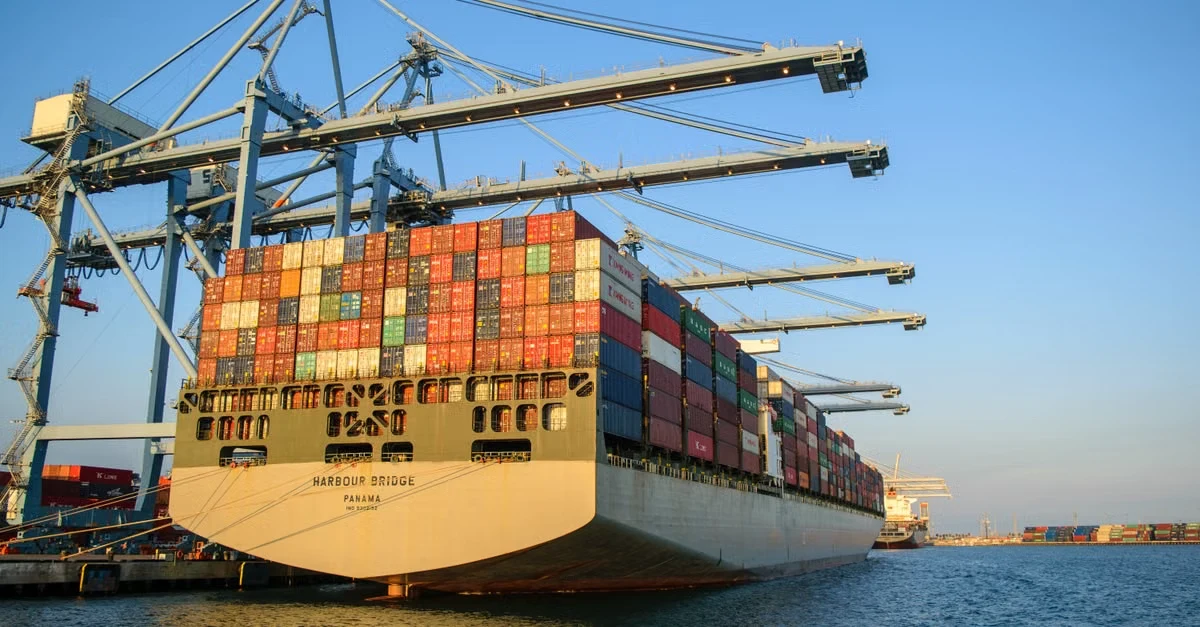
- Imported orders take much longer. Ocean transit from China to a US West Coast port runs roughly 15 to 22 days, port-to-port. Add origin handling, customs clearance, and domestic drayage, and door-to-door delivery commonly takes 8 to 12 weeks. Congestion, weather, and customs backlogs can push that to 15 weeks.
That gap matters more for compostable products than for conventional packaging, because of shelf life.
Why Long Transit Eats Into Your Shelf Life
Most compostable straw products carry a 12-month shelf life from the date of manufacture.
A straw that spends 12 weeks in ocean transit has already used up roughly 23% of that shelf life before you’ve received it. You haven’t touched a single case yet, and nearly a quarter of the product’s usable life is gone.
You then need to store it, sell it, and get it to the end user before the remaining 9 months run out.
That forces distributors to either turn over inventory faster, carry more safety stock than needed, or risk writing off product that degraded before it was used. And the degradation matters.
After one year, the straw quality and performance change. The straws may still look fine, but performance under real use conditions (flexibility, structural integrity, resistance to heat and cold) will not be what you or your customers expect.
With a domestic supplier, that math changes considerably. Product ships within weeks of your order, and you’re working with a full shelf life.
Quality Control and Problem Resolution
When something goes wrong with an order, where your supplier is located determines how fast you can fix it.
With a US manufacturer, resolution is fast.
- Something off with your specs? Call them. Same time zone, same language.
- Need to visit the facility? It’s a day trip.
- Batch fails certification? You’ll know quickly, before it costs you a customer.
With an overseas supplier, the clock works against you.
- By the time your shipment arrives and you spot a defect, you’re already 3 months in.
- Getting a replacement order made and shipped takes another 2 to 3 months.
- That’s your customer’s order delayed and a non-conforming shipment you’ve already paid for.
Want to audit an overseas factory? That means flights, visas, and a time zone that makes simple back-and-forth take days.
Certifications help fill the gap. BPI, TÜV Austria, and USDA Biobased all require real testing and ongoing compliance. So, if your supplier can provide these, that’s a positive.
How US-Made Products Simplify State Compliance
About 20 US states now ban PFAS in paper and fiber food-contact packaging.
Regulations are in effect in New York, California, Washington, Vermont, Connecticut, Colorado, Minnesota, Hawaii, Oregon, Rhode Island, Illinois, and Maine.
More states are moving in this direction. Roughly 350 PFAS-related bills were introduced across 39 states in 2025 alone.
These laws typically require a Certificate of Compliance and, in some cases, 3rd-party lab testing showing less than 100 parts per million total fluorine. Oregon sets penalties of $500 per day for wholesalers found to be in violation, for example.
With a US manufacturer, this is straightforward. Your supplier speaks your language, operates under your laws, and keeps their paperwork audit-ready. Compliance records, batch test reports, and chain-of-custody documentation are all a phone call away.
With imported products, the documentation chain is longer. You’re often working through a US importer who sourced from an overseas distributor who works with a factory.
Each link in that chain is a place where documentation can be incomplete, outdated, or inaccurate.
If your customers distribute into markets with specific composting infrastructure requirements, you need suppliers who can document compliance at that level of detail.
Supply Chain Resilience After Recent Disruptions
Building your compostable packaging program around a single overseas source is a risk most distributors have already learned the hard way.
What the Pandemic Revealed
The COVID-19 pandemic exposed exactly how dependent many distributors had become on single-source overseas supply chains. Foodservice packaging was among the hardest-hit categories.
When factories in China and Southeast Asia shut down, and freight rates spiked, operators ended up waiting months just to restock basic items. That experience pushed a lot of procurement teams to rethink where they source from.
Kearney’s 2024 Reshoring Index found that US imports from 14 Asian low-cost countries dropped from $1.02 trillion in 2022 to $878 billion in 2023, driven largely by a 20% reduction in Chinese imports.
For the first time since 2013, Mexico surpassed China as the largest exporter to the US, with Mexican goods up 32%.
Geopolitical Risk Isn’t Going Away
If you’re not living under a rock, you would know that US-China trade tensions have escalated steadily in the last decade. Tariff rates on Chinese goods went from roughly 3% to over 20% in that period.
The February 2026 Supreme Court ruling on IEEPA tariffs introduced new legal uncertainty. Companies that built procurement strategies around stable, low-tariff Chinese supply chains have had to recalibrate more than once.
Domestic sourcing does not eliminate supply risk, but it does reduce the number of variables outside your control.
A US manufacturer like NantBioRenewables can sign supply agreements with you. They can also hold safety stock and manufacture daily, 24/7. So you carry less inventory, absorb less shelf-life loss, and have fewer single points of failure.
The “Made in USA” Factor in Customer Perception
Your customers care about where their packaging comes from, and for certain accounts, it goes beyond preference. It affects whether you can win the business at all.
For institutional buyers, “Made in USA” carries real procurement weight. You’ll see many federal and state-level policies actively favoring domestic products:
- The Buy American Act requires federal agencies to purchase domestic goods wherever practicable, with price preferences adding 20 to 50% on top of any foreign bid.
- The USDA National School Lunch Program requires schools to buy domestic products with more than 51% domestic content.
- Federal domestic-content thresholds are continuing to rise, making this more relevant for institutional foodservice accounts over time.
For hospitality and foodservice brands, the value is more about marketing. US-made compostable packaging is a story your customers can tell their guests.
It pairs the sustainability angle with a local sourcing angle, which carries weight in premium dining, hotels, and event venues.
NantBioRenewables has also covered the Made in USA advantage for foodservice businesses in detail, which is worth a read if this is a factor for your accounts.
One thing to watch: the FTC’s “Made in USA” standard requires that “all or virtually all” of a product be domestic in origin. Enforcement has intensified, with a Trump executive order in March 2026 directing the FTC to prioritize US-origin claims.
Before you promote a product as US-made, verify it actually qualifies under FTC rules rather than taking a supplier’s word for it.
The True Cost of Imported Compostable Packaging
Compostable packaging already costs more than conventional plastic, somewhere between 10 and 40% more upfront, depending on material and product type.
When you’re evaluating imported versus domestic compostables, the unit price difference is real, but it’s far from the full picture.
Before you compare price tags, it’s worth stepping back on what you’re actually comparing. Some operators default to paper as the “affordable, sustainable” option.
But most paper plates and containers have a plastic film inside, which means they can’t be composted at all.
Paper straws carry a hidden per-transaction cost, too. Most customers need 2 to 3 straws to finish a single drink, since paper straws go soft mid-use. That makes the actual cost per drink higher than 1 compostable straw that holds up from start to finish.
Once you’re comparing like-for-like compostable products, the landed cost of the imported product goes well beyond the invoice price:
- Tariffs and duties (which can approach 30% for Chinese-origin products).
- Ocean freight (a 40-foot container ran $2,000 to over $7,000 in 2026, depending on route and timing).
- Customs brokerage, MPF, HMF, insurance, and drayage.
- Larger minimum order quantities force you to order more than you need.
- Inventory carrying costs on that over-ordered stock.
- Shelf-life write-offs occur if the product doesn’t move fast enough.
- Replacement cost and lost sales when quality issues surface months after receipt.
Importers who budget only for the unit price and ocean freight routinely find their actual landed cost 20 to 40% higher than expected.
With the domestic product, the cost per unit is typically higher. The minimum order quantities are usually lower, the lead times are shorter, and the shelf-life math works in your favor.
You carry less inventory risk and absorb fewer hidden costs. Whether domestic sourcing comes out cheaper overall depends on the product and your distribution model, but the comparison is rarely as simple as the unit price suggests.
Questions to Ask Before You Commit to a Supplier
Switching suppliers or adding a new one is a commitment. Before you sign anything, here’s what you should be asking.
Where is this actually made?
- What’s the factory address? Not the US office address. The actual manufacturing facility.
- Do you own that factory, or are you sourcing through someone else?
- Can I come visit?
Show me the certifications.
- Send over the current BPI, TÜV Austria, and USDA Biobased certificates, including issue dates. Not old ones.
- Are these certified at the batch level or just the product line?
- Can I look these up myself on the certifier’s public database?
What’s your PFAS status?
- I need a Certificate of Compliance and lab results showing total fluorine levels.
- When was the last batch tested? What was the batch number?
- Which states have you supplied to, and have you had any compliance issues?
Watch out for these red flags.
- A supplier who claims to be US-made but can’t provide a factory address is a problem.
- Transshipment through Vietnam, Thailand, Malaysia, or Taiwan is a common way to re-route Chinese-origin goods and dodge duties. It’s illegal under FTC and CBP rules, and if you’re the importer of record, it exposes you.
- If the price looks too good for a domestically made product, ask more questions.
What happens when things go wrong?
- Has your facility ever gone offline? What happened?
- Do you have a backup supplier or secondary production site?
- Walk me through how you’ve handled a major supply disruption in the past.

How to Decide Between Domestic and Imported Sourcing
This is a product-by-product decision rather than a blanket policy.
Domestic sourcing has the clearest advantage when:
- You’re buying shelf-life-sensitive items like straws and cutlery products, where transit time meaningfully consumes usable life.
- Your customers are in states with active PFAS bans, and you need clean compliance documentation.
- Your accounts include institutional buyers under Buy American requirements.
- You’re operating a JIT or lean-inventory model where smaller, more frequent orders are essential.
- You’ve been hit by tariff volatility and want predictable landed costs.
- Your customers are hospitality or foodservice brands that value and market US-made credentials.
- You need fast problem resolution when specs or performance don’t meet expectations.
Imports remain a reasonable choice (not preferable) when:
- No domestic source exists at scale for the product you need.
- You’re buying large volumes with a sufficient lead-time buffer and strong shelf-life tolerance.
- The product has minimal state compliance complexity and no PFAS exposure.
- Price competition is the primary driver, and your customers have no origin preference.
Most distributors will find their answer is a mix. Running a US-made straw program alongside an import-sourced cutlery line is a practical combination. The goal is to match the sourcing decision to each product’s specific risk profile.
Request a Sample from NantBioRenewables
Your accounts are asking for compostable packaging that performs. Wave Ware™ products are created to do exactly that. They are engineered to match or exceed traditional plastic in strength and usability, with zero pollution at the end of life.
That’s why you’ll find Wave Ware™ products in use across a wide range of sustainability-focused operations.
Hotels, resorts, and cruise lines use them. So do restaurant chains, corporate cafeterias, institutional dining programs, airports, amusement parks, and government contract facilities.
The materials science behind Wave Ware™ starts with BioCal™, NantBioRenewables’ proprietary formulation. BioCal™ is made from Ocean Calcium Sand (aragonite), a naturally occurring calcium carbonate harvested from shallow tropical seas. It also includes PLA and other polymers.
Third-party life cycle assessments confirm it sequesters more carbon than it emits during production, making it carbon-negative from the start.
NantBioRenewables’ sister company, Calcean, has also been recognized with the EcoVadis Bronze Award for its commitment to sustainability.
For distributors evaluating a US-made compostable program, NantBioRenewables manufactures daily, 24/7, so you’re never waiting on a production window.
Request a sample at [email protected] and put the product through its paces with your accounts.