



There is growing interest in sustainable production aimed at mitigating climate change, particularly the warming of the atmosphere caused by the greenhouse effect resulting from increased carbon dioxide (CO₂) emissions. Numerous studies, frequently highlighted at UN Climate Change Conferences, have shown that the 1.5 °C temperature increase during the last century was caused by human activity, consistent with temperature changes observed since the Industrial Revolution (Fig. 1).1
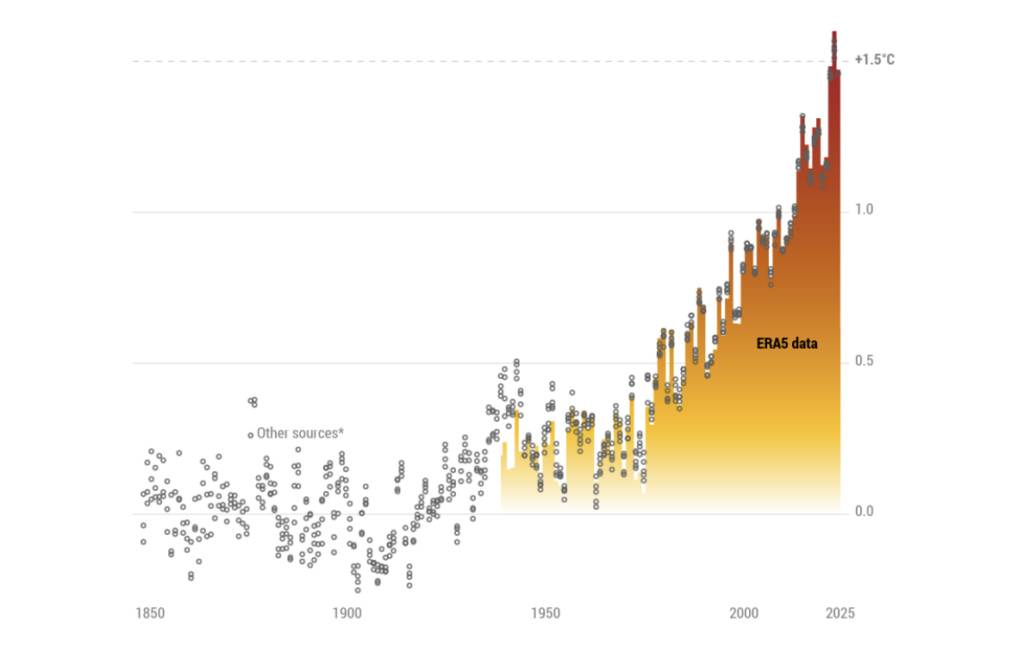
Figure 1. Global temperatures have increased from 1850 to 2025. Data adapted from the Copernicus Climate Change Service (C3S) / ECMWF report.¹
In this context, reducing the carbon footprint of materials is crucial. Bioplastics are a group of biopolymers—such as polylactic acid (PLA), starch, and polyhydroxyalkanoates (PHAs) that are naturally sourced, environmentally friendly, and compostable. They have a reduced carbon footprint because their initial ingredients, like sugars, are produced from plants, which take out CO₂ from the atmosphere during photosynthesis. Its application is limited by the high cost of biopolymers, which is still two to three times higher than oil-sourced materials like polypropylene (PP) or polyethylene terephthalate (PET).
Polymer fillers have been widely used since the last century to replace part of the polymer’s volume, making materials more affordable and improving product durability. In the current era of bioplastics as sustainable alternatives to oil-sourced plastics, fillers can make the resulting products even more environmentally friendly. Many types of fillers have been developed. Among these, mineral fillers like calcium carbonate (CaCO3), derived from limestone, have been used for a long time. Calcium carbonate is applied in both oil-based and biopolymer industries, including PP, PE, PLA, and starch.
Over the last decade, emerging technologies have increasingly shifted from carbon-reducing materials toward new carbon-negative materials. Unlike conventional manufacturing, which generates CO2 and drives atmospheric warming, and conventional biopolymers, which have a much lower carbon footprint than ordinary polymers but still emit carbon during the processing of sugars, these innovative materials have a negative carbon footprint which means their ingredients or technologies remove CO2 from the air. This shift was recently highlighted at a major sustainable packaging summit for startups led by Thomson Reuters in London, showcasing a significant surge of these technologies on the global market. Within this landscape, calcium carbonate (CaCO3) has emerged as a key player in the carbon-negative revolution.
Traditionally, calcium carbonate is obtained through mining of limestone rock, a process that releases substantial CO2 emissions. However, Alabama-based Calcean LLC has pioneered a regenerative alternative. Rather than excavating limestone rocks, engineers are now sourcing the material from a mineral called aragonite. This mineral is naturally produced by ocean microorganisms near the Bahamas, which then settles on the ocean floor closer to the shore, forming white Ocean Calcium Sand. The process of harvesting, transporting, and milling this aragonite creates a version of CaCO3 that is significantly more sustainable. Instead of limestone mining where CO2 is emitted, cyanobacteria (microalgae) capture CO2 from the atmosphere during photosynthesis to create their skeletons, connecting it with calcium cations dissolved in the seawater.3 Thus, it is microbially mediated organomineralization process.4 In this case, the CaCO3 is biogenic.3 This precipitate settles on the ocean floor to form egg-like shapes known as oolitic aragonite (Fig. 2). A Life Cycle Analysis (LCA) conducted by Calcean LLC researchers—and later verified by external experts revealed that this aragonite (marketed as OceanCal™) remains a carbon-negative material.4
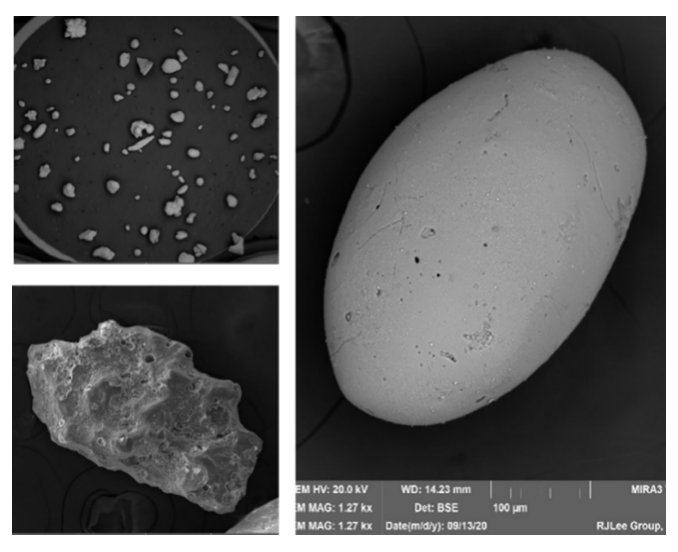
Figure 2. Scanning Electron Microscopy images of raw aragonite particles before milling with 55x, 676x and 1270x magnification (study conducted by Calcean LLC R&D department).3
It must be noted that as aragonite regenerates quickly in nature, it is considered a self-regenerative source of CaCO3. This certification relies on ASTM D6866 analytical testing, a rigorous industry standard used to determine the exact percentage of carbon originating from biogenic or renewable sources. This provides transparent, third-party verification that the material is derived from living processes rather than fossil-based or ancient geological deposits. Calcean LLC received EcoVadis Bronze Award for Sustainability in 2024 for aragonite products.
The Structural and Properties Advantage: Aragonite vs. Mined Calcium Carbonate
Despite sharing a similar chemical formula with calcite derived from mining, aragonite possesses slightly different properties originating from its distinct crystal structure, as shown in Fig. 3.
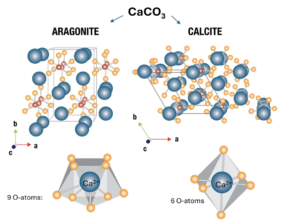
Figure 3. Comparison of the X-ray crystallography data aragonite and calcite. Adapted from Soldati et al. (2016).5
Such differences lead to slightly different physical properties compared with ordinary limestone carbonate, as shown in Table 1.
Table 1. Physical properties comparison between aragonite and calcite (Calcean LLC).4
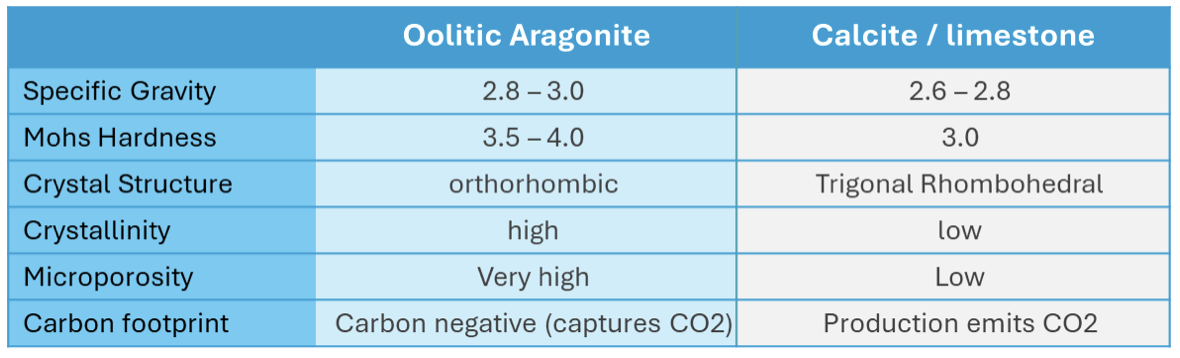
Aragonite has a higher Mohs hardness than calcite and greater microporosity. It possesses more than double the surface area of regular ground calcium carbonate. According to a report provided by Calcean LLC, which mills aragonite to 3, 5, and 8 microns, the specific surface area reaches 11.6 m2/g of powder for 3-micron particles!
The purity of aragonite derived from the sea is about 3% lower than that of calcite due to the presence of amino acids and metal oxides, which served as the building blocks for the microorganisms from which it was derived.
Since aragonite is a form of CaCO3, it can be slightly hydrolyzed in soil – especially in acidic conditions, where it neutralizes acidity through the release of Ca cations. Aragonite is more soluble than calcite, making it an excellent fertilizer and a source of vital calcium for plants and more bioavailable than calcite. It provides high bioavailability of calcium for richer plants growth, enhances fertilizer performance, and promotes a healthy microbial community.6
Benefits of Aragonite Filler: Example of Aragonite-Reinforced Compostable Wave Ware™ Trays with Enhanced Sustainability
Like ordinary calcium carbonate, aragonite can be used as a filler.7,8 Being a carbon-negative material by nature, the addition of aragonite to any polymer reduces its total carbon footprint. In the case of biopolymers, where the carbon footprint is already inherently low, the addition of aragonite can drive those levels even lower. More importantly, it addresses a critical market barrier: cost. Currently, biopolymers are two to three times more expensive than their oil-based counterparts. By integrating aragonite as a functional filler, manufacturers can maintain eco-friendly standards while significantly reducing the overall price point, making sustainable packaging more competitive with traditional plastics. This surface treatment is essential because it increases the mineral’s affinity within polymer blends. Stearic acid coating of aragonite similar to limestone based CaCO3 increases its affinity in polymer and biopolymer blends and protecting from moisture.4,9
One of such biopolymers is polylactic acid (PLA), one of the most common industrially compostable biopolymers in industry. Its applications range from automotive to packaging products.10 PLA can be blended with aragonite,11,12 just like ordinary oil sourced materials, e.g. polypropylene. For example, NantBioRenewables AL LLC has developed a formula utilizing oolitic aragonite blended with biopolymers to reduce costs and increase sustainability of the products. This is a masterbatch called BioCal™ from which it produces compostable sustainable drinking straws and packaging products such as trays and plates. Because of aragonite’s carbon negative nature and low carbon footprints of applied biopolymers, these products have additionally reduced carbon footprint. Aragonite containing products also exhibit superior properties when compared with similar compostable trays on the market made of other materials (Fig. 4).
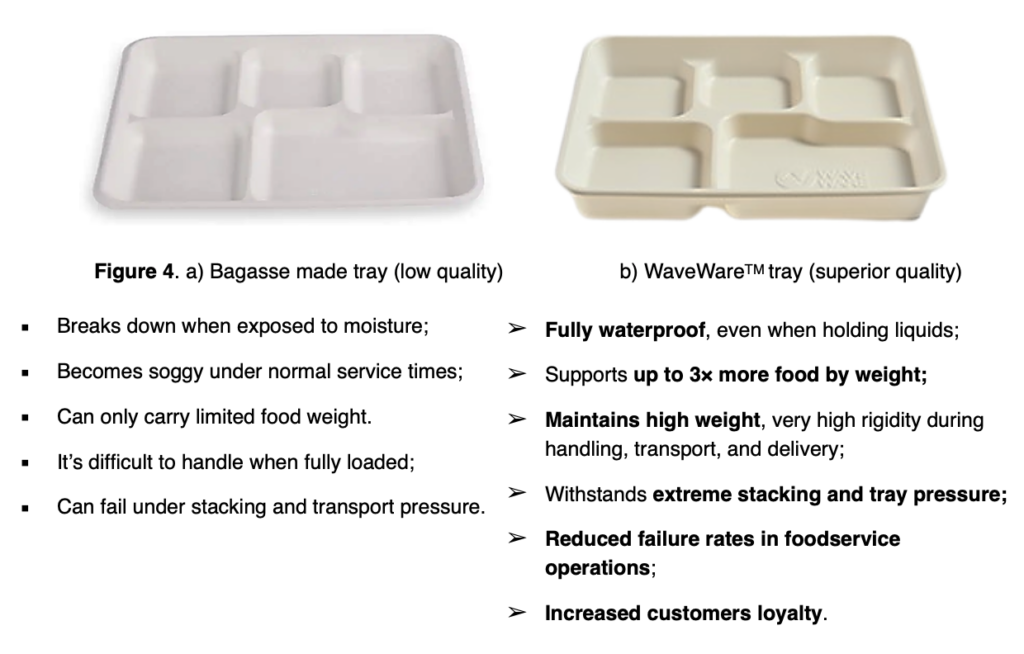
Molded fiber trays manufactured from bagasse are widely perceived as sustainable alternatives to plastic; however, their material structure introduces significant functional limitations in foodservice environments, especially in high-moisture applications. They have limited compatibility with wet or liquid-rich foods which restricts their use in modern foodservice. Bagasse has high water absorption level due to capillary penetration which is resulting in loss of rigidity and premature structural failure. Bagasse also has low flexural modulus and thus its deflection resistance is very low even after the addition of ribs. This limits the allowable food load, reduces handling stability, and increases the likelihood of food products falling during transport. Very low compression and tray pressure resistance negatively impact stackability and logistics efficiency. Additionally, hot food or sauces can easily spill, potentially causing harm to the customer.
In contrast to fiber-based trays, aragonite-reinforced biocomposite food trays have enhanced properties, making them superior in quality (Fig. 4b). NantBioRenewables AL LLC has achieved, with their compostable products, mechanical properties comparable to non-compostable PET or PP trays.
BioCal™ blend-made trays are fully waterproof, enabling their use with high-moisture foods and free liquids and trays don’t become soggy. High dimensional stability and rigidity ensure secure handling even when the tray is fully loaded. This is also beneficial for restaurants, as the trays can withstand higher load capacities, allowing customers to purchase more food and increasing sales for the catering service.
It is well-documented that CaCO3 has been used as an anti-blocking additive; biogenic aragonite is no exception, significantly mitigating adhesion between stacked surfaces. In commercial applications, such as the thermoformed trays produced by NantBioRenewables AL LLC, the incorporation of aragonite eliminates stacking interference, thereby increasing automated handling speeds and improving throughput efficiency.
As aragonite is a fertilizer and soil acidity regulator,6 it is reasonable to assume that during the degradation of biopolymers in compostable trays, straws, or other products containing aragonite, the remaining aragonite can dissolve into the soil, potentially acting as a fertilizer that reduces high soil acidity and buffers pH, thereby creating conditions more favorable for plants. Aragonite’s superior surface area and hydrophilic nature may make this buffering effect even more pronounced than that of mined calcium carbonate. In the case of industrially compostable aragonitecontaining products, bioavailable calcium may provide additional benefits in soil environments by enriching compost quality, improving soil health, and supporting regenerative agriculture. However, further research is needed to confirm these effects.
Some research papers show that the integration of CaCO3 can decrease degradation time in PLA composites. PLA’s degradation is caused by hydrolysis, where water cleaves ester bonds in the amorphous regions of a polymer chain. PLA degradation in compostable environments is caused by enzymatic hydrolysis. Research conducted by Japanese authors revealed that in the presence of the proteinase K enzyme, PLA films made with the addition of 5 and 10 wt.% of CaCO₃ particles biodegraded much faster than neat PLA films, resulting in significantly higher weight loss.12 There was no size effect of the particles or surface treatment of the films.¹² Similar results for faster biodegradation were shown in PLA composite mulch films with CaCO₃. Under strong acidification (final pH < 5.5) caused by soil microorganisms, accelerated biodegradation was found for CaCO₃-containing biodegradable/compostable films.¹³ Based on these studies, in the case of aragonite application as a filler, it is possible to expect faster biodegradation of aragonite-containing PLA-based products.
All of the above allowed NantBioRenewables AL LLC to be recognized at two prestigious packaging exhibitions: it was named a Finalist for the 2025 Reuters Events Global Sustainability Award in Product Innovation for the BioCal™ Carbon-Negative Ocean Calcium Sand-containing Compostable Straws in London, and the Wave Ware™ protein tray made of BioCal™ with aragonite became a finalist in the Sustainability Awards by Packaging Europe in the Netherlands.14
Looking Forward: The Case for Aragonite
Aragonite can be blended like ordinary calcium carbonate, enabling products that meet the highest composability standards while starting with carbon-negative raw materials.
As industry continues moving away from persistent plastics toward materials that return safely to nature, aragonite calcium carbonate stands out as a key enabler of that transformation. While the packaging industry has long used mined calcium carbonate (typically calcite) as a filler material, emerging research and development demonstrates that aragonite, a naturally occurring calcium carbonate harvested from ocean sources, offers excellent properties and increased sustainability.